Intelligent labor market?
Artificial intelligence (AI) is a key future technology with far-reaching consequences for economic development and is central to the future competitiveness of companies, industries and thus also regions. AI will lead to far-reaching changes in the labor market, and these changes will vary greatly in terms of professions, industries and regions. On the one hand, AI poses the threat of replacing jobs (displacement effect), while on the other hand it offers enormous growth potential in many industries and regions (productivity effect). In order to investigate this AI transformation, international labor market research has so far focused primarily on the question of which activities in which occupations could be replaced by AI in the future. However, this substitutability potential does not allow to capture the actual changes in the labor market such as something changes in demand. The Intelligent Labor Market? project therefore aims to capture the changes in the labor market based on AI demand in occupations, industries, and regions, and thus examine the employment effects of the AI transformation.
Research objectives
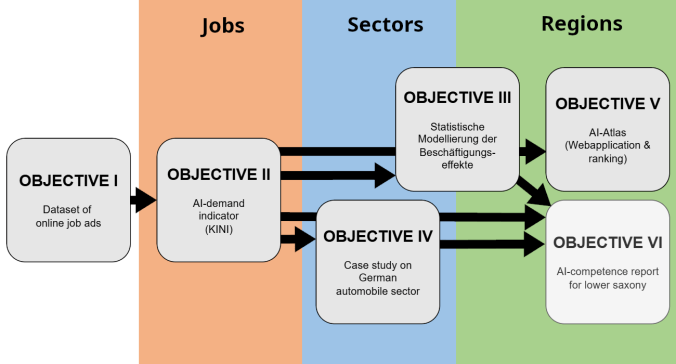
To capture AI demand in the labor market, the project will build a new dataset based on online job advertisements. This objective is supported by Dr. Gábor Kismihók (Data Scientist at LUH). In collaboration with Dr. Anne Otto from the IAB – the research institution of the German Federal Employment Agency (BA) – the AI demand indicator will be developed and validated based on extensive online data. This indicator allows to statistically model the relationship between AI and employment in order to better understand the impact of the AI transformation.
In addition, the automotive sector in particular, as a key industry in Germany, is facing major upheavals as a result of the AI transformation. The AI demand indicator as well as other output oriented indicators are therefore used for a case study on the AI transformation within the automotive industry to compare the automotive clusters in Lower Saxony, Baden-Württemberg and Bavaria.
In addition to the scientific investigation of the effects, the Intelligent Labor Market? project also aims to make the AI demand indicator available to a broad public and to discuss its results with Lower Saxony’s economic development agencies. For this purpose, a new web application, the AI Atlas, is being developed to make the indicator available to the public online. Furthermore, in order to summarize a more in-depth analysis of the AI transformation of the labor market for policy makers and regional stakeholders and also to capture gender differences regarding supply and demand of AI competencies on the labor market, an AI competency report for Lower Saxony will be compiled.
A research project by:

sponsored by:

Project Lead
Dr. Kerstin J. Schäfer
Institute of Economic and Cultural Geography
Tel. +49 511 762 19403
schaefer@wigeo.uni-hannover.de
Schneiderberg 50
30167 Hannover
Project Implementation
Matthias Kapa
Institute of Economic and Cultural Geography
Tel. +49 511 762 19404
kapa@wigeo.uni-hannover.de
Schneiderberg 50
30167 Hannover
Dr. Lennart Schott
Institute of Economic and Cultural Geography
Tel. +49 511 762 3310
schott@wigeo.uni-hannover.de
Schneiderberg 50
30167 Hannover
Domenik Kern
Lab Learning and Skill Analytics
Tel. +49 162 1828 497
domenik.kern@stud.uni-hannover.de
Lange Laube 30
30167 Hannover
 Intelligenter Arbeitsmarkt?